
Tariff pass-through is not over
Raymond James Chief Economist Eugenio J. Alemán discusses current economic conditions.
Several months ago, analysts and economists seemed to be convinced that the pass-through from tariffs to higher prices had already occurred. However, new research from the Federal Reserve of New York’s Liberty Street Economics is challenging that view. In a research piece published on July 8, 2026, titled More Tariff Pass-Through Is in the Pipeline, the authors argue that, among all importing firms, 47% of service firms are planning to raise prices during the next year while 44% of manufacturers are planning to increase prices during the same period of time.1
We typically don’t like to bring personal anecdotes into this publication, but some of us have been checking our online bills, and we have seen very large price increases for our subscriptions to newspapers, internet services, streaming services, etc. We typically get charged automatically nowadays, and if you are also in that same boat, check your online charges to see what we are talking about.
What we are seeing is in line with our argument over the last year that many firms chose not to adjust prices but to adjust the level of employment in order to keep costs contained. This is one of the reasons why we saw employment slowing down from a monthly average of about 121,600 in 2024 to a monthly average of about 9,700 in 2025. This was the immediate response from firms to the uncertainty created by the new tariffs, which seemed to change frequently throughout last year.
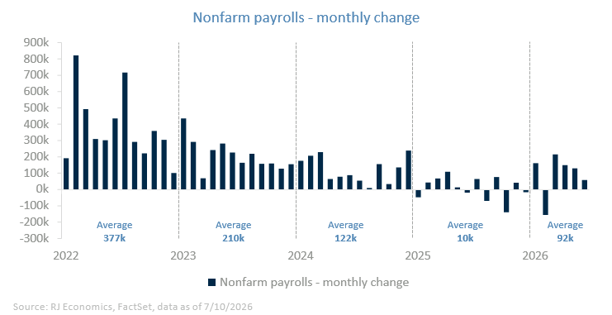
While tariff uncertainty hasn’t completely disappeared, it has diminished, and firms are feeling less uncertain about the future. This reduction in uncertainty is showing up in the magnitude of hiring, with average employment growth during the first half of the year accelerating to about 92,000 per month. It is still too early to say whether this employment momentum is here to stay, but if firms are upping their employment levels, it means they have no choice but to increase prices in order to cover higher delayed costs due to tariffs, even if these tariffs have been in effect, in some cases, for a little more than a year.
The New York Fed paper points to two main reasons for justifying higher prices going forward: first, “some businesses operate under contracts with fixed selling prices and are unable to raise prices until such contracts expire, forcing them to absorb cost increases in the meantime”; and second, “some businesses reported taking a ‘trickle up’ approach to price increases, where they gradually raise prices over time rather than immediately raising prices to fully cover tariffs. This pricing strategy allows firms to avoid shocking their customers with sharp price increases while retaining the ability to accelerate price increases if input costs continue to rise. Moreover, uncertainty surrounding future tariff policies – including potential rate changes, exemptions or tariff responses from other countries – may be causing some firms to adopt cautious, incremental pricing strategies rather than making large, discrete adjustments. This behavior extends the period over which tariff-related price pressures work their way through the economy.”
If, as this research indicates, there has been a delayed response from firms to adjusting prices in the face of higher tariffs and the uncertainty they created, then, as we have argued during the past year, the only other alternative to control costs was to reduce and/or suspend hiring decisions. Although firms’ cost structures vary between services versus manufacturing sectors, labor costs represent a very large component of costs for firms.
This is bad news for inflation and for monetary policy
If the above is true and almost 50% of importing firms are planning to raise prices during the next year and the economy continues to face other shocks, be it because of higher oil prices or strong AI investment, etc., this is not good news for the Federal Reserve, for inflation, and for interest rates. We have argued that the Fed could keep interest rate unchanged and be patient because inflation will trend down over time. But Fed patience seems to be running short, be it because it really believes it has to do something about it or because of recent criticism or political pressure.
If we look at this week’s release of the Fed minutes from June’s FOMC meeting, the risks for higher rates have increased considerably. But as we argued after the last FOMC meeting, we think that, although Fed members’ views were divided, they decided to delay any decision until the job of the different task forces is done. However, we also said that they needed to see core Personal Consumption Expenditures (PCE) prices continue to behave. If that is not the case, our view is that Fed members are going to push for higher rates sooner rather than later. Below, we include some excerpts from the minutes to give a sense of what happened during the meeting:
- Inflation risks remain skewed to the upside: “Participants judged that the risks to the inflation outlook were still tilted to the upside. Many participants noted that elevated commodity prices and supply disruptions could persist longer than currently anticipated. Several participants reported that their business contacts were facing notable cost pressures. Some participants observed that the sharp rise in input costs reported in business surveys raised concerns about the potential for higher energy and commodity costs to pass through more broadly to final goods prices.”
- Unanimous support for holding rates steady: “In their consideration of monetary policy at this meeting, all participants supported maintaining the current target range for the federal funds rate.”
- Policy debate shifts toward inflation risk: “Participants generally assessed that information received over the intermeeting period suggested that upside risks to price stability remained elevated while downside risks to achieving maximum employment had moderated a bit. A few participants commented that, in light of these developments, there was a case for raising the target range for the federal funds rate, but those participants indicated that they supported maintaining the current target range at this meeting. Several participants remarked that they did not see the current policy stance as restrictive, while a few other participants commented that they saw the current policy stance as slightly restrictive.”
- A wide range of policy paths remain on the table: “With regard to the outlook for monetary policy, amid high assessed uncertainty, various participants discussed a range of scenarios for the evolution of the economy and for future monetary policy actions. … Regarding participants’ individual assessments of appropriate monetary policy under what each participant judged to be the most likely scenario for the economy, many participants indicated that the appropriate level of the federal funds rate would be within or slightly below the current target range at the end of this year. Many other participants, however, assessed that the appropriate level of the federal funds rate would be above the current target range at the end of this year. Participants noted that their future policy actions would depend on incoming information.”
- FOMC signals less forward guidance, more flexibility: “A number of participants noted that it was an opportune time to consider significant changes to the FOMC’s postmeeting statement. A majority of participants remarked that they saw advantages in shortening the statement. Most participants emphasized that they preferred not to repeat the language in the previous postmeeting statement that had suggested an easing bias regarding the likely direction of the Committee’s future interest rate decisions.”
- Tariffs, energy and AI are all feeding inflation: “Both total and core inflation were higher than their levels a year earlier, a development that the staff attributed to a variety of factors, including the pass-through of past tariff increases, higher energy and input costs stemming from the conflict in the Middle East, and the surge in demand related to the AI buildout.”
- Firms have been slow to fully pass through costs: “Several participants noted, however, that firms in their Districts reported that they had been cautious about increasing prices, citing concerns that higher prices could reduce demand or their market shares.”
- The Fed’s inflation forecast moved higher: “The staff's inflation forecast for this year and the next was higher than the one prepared for the April meeting, reflecting incoming data, higher energy prices and other input costs due to the conflict in the Middle East, and the effects of the AI buildout on consumer prices.”
1More Tariff Pass-Through Is in the Pipeline, Liberty Street Economics, by Jaison R. Abel, Mary Amiti, Richard Deitz, Sebastian Heise, and Nick Montalbano. July 8, 2026. https://libertystreeteconomics.newyorkfed.org/2026/07/more-tariff-pass-through-is-in-the-pipeline/
Economic and market conditions are subject to change.
Opinions are those of Investment Strategy and not necessarily those of Raymond James and are subject to change without notice. The information has been obtained from sources considered to be reliable, but we do not guarantee that the foregoing material is accurate or complete. There is no assurance any of the trends mentioned will continue or forecasts will occur. Past performance may not be indicative of future results.
